 Edge
Edge
Edge Bitcoin fee presets versus custom fees
Edge lets you choose Bitcoin fee presets or a custom rate, while the selected rate and the transaction’s virtual size determine the total mining fee. Low, Standard, and High express different confirmation priorities. A custom setting gives you direct control over the rate used for the payment. Neither choice reserves a place in a block. The wallet combines the selected rate with the transaction that it builds from your available funds. That makes timing, input structure, and the displayed total relevant to the choice. For an urgent payment, a low total alone says little about whether its rate competes with other pending transactions.
Larger Bitcoin transactions can cost more at the same fee rate without gaining extra confirmation priority.
Presets, custom rates, and block space
Fee presets connect the wallet’s market estimate to a confirmation preference, while the transaction builder turns that preference into a Bitcoin payment. Edge offers Low, Standard, and High Bitcoin fee presets alongside a custom fee option. Their associated amounts change with the fee market.
A custom entry replaces the recommended rate with your chosen rate for that transaction. Changing the rate can change which inputs the wallet needs, and no custom rate guarantees a confirmation time.
Miners choose which valid transactions to include in a block. Demand for block space can move between preparation and inclusion, so a custom rate can face different competition later.
What should you review before sending Bitcoin?
Review the fee-rate unit, total mining fee, payment amount, and spendable Bitcoin balance before authorizing a transaction, especially when its timing matters.
Rate units and the total charge
A rate measures the fee per unit of transaction size; the mining fee is the amount that the whole transaction pays. Bitcoin fee comparisons commonly use sat/vB, meaning satoshis per virtual byte. Read a custom entry with its displayed unit. Entering an intended total as a per-byte rate can produce a much higher charge.
Editing the payment can change the transaction that the wallet needs to construct. Review the recalculated fee after changing an amount.
Funds available for the payment
The selected Bitcoin wallet needs enough spendable funds for the recipient’s amount and the network fee. Balances in other assets do not supply the Bitcoin needed for this on-chain fee. A full-balance payment allocates part of the balance to the mining fee, leaving less for the recipient.
Why can the same fee rate produce a different total?
The same Bitcoin fee rate produces a different total when the wallet constructs a transaction with a different virtual size, including different inputs or outputs.
Inputs, outputs, and change
A Bitcoin balance consists of unspent transaction outputs, or UTXOs. An input spends a previous output; new outputs assign value to the recipient and, when needed, return change to the sender. Using more inputs adds transaction data. A wallet funded through many small receipts can therefore need a larger transaction than one funded through fewer receipts.
Payment value does not directly measure data size. A smaller payment can cost more to send when it needs more transaction data at the same fee rate.
SegWit and virtual size
Segregated Witness, commonly called SegWit, gives witness data less weight in Bitcoin’s transaction-size calculation. Bitcoin defines virtual transaction size as transaction weight divided by four, rounded up to a whole virtual byte. The wallet supports SegWit transactions. Its total fee still reflects the actual input and output structure, so SegWit support does not establish a fixed transaction size.
Bitcoin fee settings and calculation rules
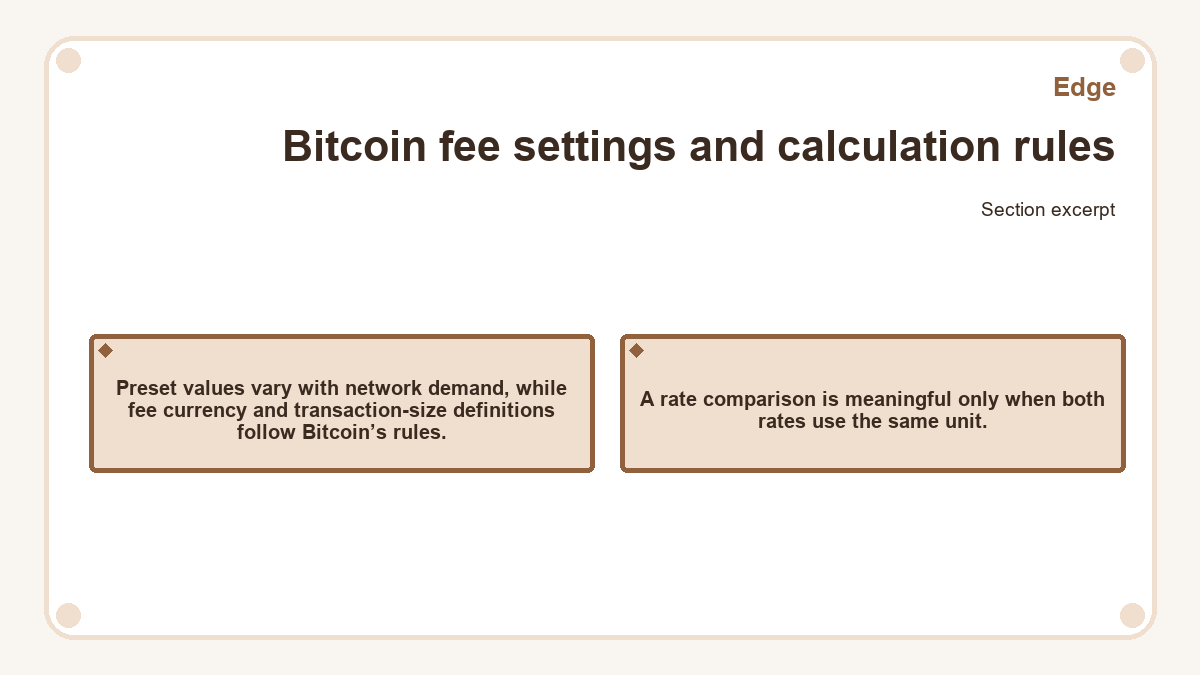
Preset values vary with network demand, while fee currency and transaction-size definitions follow Bitcoin’s rules. A rate comparison is meaningful only when both rates use the same unit.
| Setting or quantity | Value or definition | Where it applies | Common error or constraint |
|---|---|---|---|
| Fee presets | Low, Standard, and High | Wallet-estimated confirmation priority | A priority label does not reserve a block. |
| Manual fee option | Custom rate | The transaction being prepared | An unsuitable rate can leave the payment unconfirmed. |
| Mining-fee currency | BTC | The on-chain Bitcoin fee | Available Bitcoin must cover the payment and fee. |
| Fee-rate comparison unit | Satoshis per virtual byte, or sat/vB | Bitcoin transaction fee comparisons | A rate is different from the total fee. |
| Virtual size | Transaction weight divided by four, rounded up | Size measured in virtual bytes, or vB | Raw byte size can differ from virtual size. |
| Total mining fee | Input value total minus output value total | An ordinary Bitcoin payment | The recipient’s amount alone does not determine the fee. |
| Initial confirmation | Inclusion in a block | The transaction’s blockchain status | A transaction identifier alone does not prove confirmation. |
| Presets and custom rates affect the proposed fee; miners determine when a valid transaction enters a block. | |||
Pending payments and fee acceleration
An unconfirmed Bitcoin payment can wait when miners have more competitive transactions available, even though the wallet has already signed and broadcast it.
Broadcast and confirmation
Signing authorizes the transaction, and broadcasting sends it to network peers. A transaction identifier lets you inspect the payment’s record; it does not establish block inclusion. A recipient may also wait for further confirmations before treating the payment as settled.
Changing a fee preference for a new send does not alter an already broadcast transaction. A duplicate payment can create an additional transfer if both transactions confirm.
Child pays for parent
Fee acceleration through child pays for parent (CPFP) requires an unconfirmed output that you control and a wallet that permits spending it. A CPFP transaction spends an output of an unconfirmed parent transaction. The child’s additional fee can make mining the dependent transactions together more attractive. Both transactions consume block space, adding a cost that a single payment would avoid. If no suitable output is available, this method cannot accelerate the payment.
A low-rate payment may confirm after demand falls, while some nodes may drop it from their mempools. Disappearance from one node is not proof of cancellation everywhere.
Mining fees alongside swap charges
The Bitcoin mining fee goes to the miner that includes the payment in a block. An exchange or other integrated service can apply its own charges. A swap quote can therefore involve costs beyond the sending wallet’s network fee. Customizing that Bitcoin fee does not set the partner’s spread, service charge, or conditions for accepting a deposit. Where a swap requires timely funding, its deposit terms can change whether a low-priority transfer fits the task.
Key questions about Edge
Does changing the Bitcoin display unit in Edge change the mining fee?
Changing the display unit changes how the wallet expresses an amount, not the underlying Bitcoin fee. A fee shown in BTC or a smaller Bitcoin denomination represents the same charge after conversion. Keep the display denomination separate from a custom fee-rate unit when reviewing the payment.
Are transfers between my own Edge Bitcoin wallets free of mining fees?
An on-chain transfer between your own Bitcoin wallets still pays a mining fee. Owning both wallets does not remove the transaction from the blockchain or reduce its required block space. Any difference in the total fee comes from transaction structure and the selected rate.
Who selects the fee when someone sends Bitcoin to my Edge wallet?
The sender selects the mining fee for the transaction that pays your receiving address. Receiving that ordinary on-chain payment does not require you to attach a separate Bitcoin mining fee. A later transaction that you initiate, including an eligible acceleration transaction, has its own fee.
Is there a lowest custom Bitcoin fee that always confirms?
No fixed custom fee rate assures confirmation under every network condition. Competition for block space changes, and nodes apply their own transaction-relay policies. A rate that worked during a quiet period can become insufficient during congestion. A node’s relay threshold also does not promise inclusion in a block.
How do exchange-rate changes affect a Bitcoin mining fee shown in cash terms?
Exchange-rate changes can alter the cash equivalent of a mining fee without changing its Bitcoin amount. After a transaction is signed, a later price movement does not rewrite the fee contained in that transaction. Compare the Bitcoin amount and the rate’s unit separately from any cash conversion.
Can a confirmed Bitcoin mining fee be lowered afterward?
A confirmed transaction’s mining fee cannot be edited afterward. Selecting a different preset or custom rate for another payment changes the fee for that new transaction, without changing the fee in the transaction that already confirmed.